Recidivist Parents
... and Me and Tucker

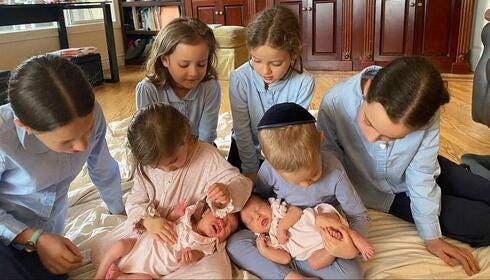
The essay below is an edited version of one that Religion News Service published last year.
It might have been her Germanic accent that evoked my blunt response. I can’t say for sure.
It was more than 40 years ago in the suburban Northern California neighborhood where my wife and I were living then. I was wheeling our two young daughters in a double stroller outside a supermarket. The older lady looked at me disapprovingly and said without the hint of a smile, “I see you don’t believe in zero population growth.”
Where my rude retort came from, I can’t say either. “When we reach 6 million,” I said, with exaggerated politeness, “we’ll consider stopping.”
The retort was momentarily gratifying, and even perhaps appropriate – my Polish-born father and father-in-law each had siblings who never made it out of young adulthood, thanks to some people’s decision to starve, shoot, gas or burn them; and several of our children born after that supermarket exchange carry the names of those unmet great-aunts and great-uncles who died at the hands of Hitler and his henchmen in World War II.
But really, as I see it today, my invoking of our murdered relatives’ memory to the fraulein was beside the point. The point being, simply, that children are a blessing.
I was reminded of the long-ago moment while reading a review of “Hannah’s Children: The Women Quietly Defying the Birth Dearth,” by social scientist Catherine Pakaluk, who interviewed 55 college-educated women who were raising five or more children. Pakaluk describes the joys of raising children, a nearly countercultural stance in a society that seems to emphasize the plight of beleaguered parents more than the deep sense of fulfillment children grant us.
There are the sleepless nights and seemingly incessant diaper changes, followed by chasing toddlers and the trials presented by adolescents. There are strains in some households over which parent does what, and the material demands of children. But, above all, children are a blessing.
And for some of us, an impertive. My waspish reply four decades ago notwithstanding, “replacing” some of those murdered during the Holocaust – or, at least, perpetuating their memory – is only part of why Orthodox Jews like my wife and I chose to raise large families.
Jewish religious law, or halacha, prioritizes the bringing of new people into the world. While there are situations where birth control is permitted and even advised, those are exceptions that prove the rule.
People like the California matron may look upon large Orthodox Jewish families with scorn; others regard us with pity. It must be so hard, they likely think, to manage so many children.
Yes, children require time and effort. But Haredi parents are not pitiable. Women are proud of motherhood, and while they may generally have smaller biceps than men, they have other strengths greater than those of males. Caring husbands can and do share in parenting and the housework. Fathers caring for young children or shopping are not an uncommon sight in Haredi neighborhoods.
In the end, it’s life that’s a handful, and challenges come in all guises. I sometimes imagine that each of us is assigned a “quota” of child-related challenges: If a couple has one child, the entire package of assigned angst will emerge from that singleton; if there are many children, the content of the problem packet will be diluted, spread out among the progeny. And, as a result, each challenge will be less urgent, easier to manage.
While there may be those, such as the character W.C. Fields inhabited, who disdain children, I think most people would readily concede that a child is a blessing. What they might consider is that blessings are not diminished by their abundance; they are multiplied.
The modern world is decidedly, undeniably materialistic. When someone is heard to be “successful,” the conclusion that he or she has accomplished something truly meaningful is, at best, premature. It usually means that money has been made, and that’s all. So we’re left with an enlightening irony: Were children dollars, no one would begrudge anyone an abundance of them.
My wife and I are grandparents now, many times over; our children and their spouses are all Haredi Jews raising families of their own. We haven’t forgotten some of the difficulties and economic challenges that attended our young family days.
But what remain with us most prominently from our child-rearing years are things like the profound (often profoundly funny) observations our new-to-language youngsters came up with, and the wonderful experiences we shared with our children at all ages. We recall the flood of feeling that came with an unexpected hug.
Our children-turned-parents amaze us by “how well” they turned out and how close they remain to one another. They will readily tell you that, looking back on their youths, while they may have kvetched here and there, they didn’t much suffer for their multiple siblinghoods. There were things that they didn’t get to experience or own — no overseas vacations, oversized dolls or overpriced action figures. No latest clothing fashions or expensive shoes. No television commercials telling them that they were lesser humans for the lack. No television, for that matter. Somehow, they survived.
What they had, though, were real, live babies to help care for (and from whom they learned about responsibility, something that later came to serve them well). And what they never lacked was someone on hand to boost them up to a tree branch, or a pair of someones to hold the ends of a jump rope. They had sibling roommates to shmooze with late at night and handy choirmates on call, ready to belt out or harmonize any selection their spirits moved them to sing. They were happy, despite — I’d argue, because of — their siblings.
We remain grateful for the precious souls with which we were entrusted. And we prayed that God guide us to make the right decisions as we raised them, and that God protect them.
It might seem strange for a Haredi Jew to be moved by a gospel-style piece of music, but Bob Dylan’s achingly sung words have always resonated with me:
As his youth now unfolds
He is centuries old
Just to see him at play makes me smile
No matter what happens to me
No matter what my destiny
Lord, protect my child
The whole world is asleep
You can look at it and weep
Few things you find are worthwhile
And though I don’t ask for much
Lord, protect my child
In the end, all the sleepless nights, emergency room visits, fussing, fights and tribulations were overwhelmed by the sweetness that prevailed. Lord, protect our children, and theirs… and all.
––––––––––––––––––––––––––––-
Me and Tucker
Back in the summer of 2020, in an Ami Magazine column, I called attention to the ugliness that was, and remains, Tucker Carlson.
At that time, the then-Fox News personality had attacked Senator Tammy Duckworth for equivocating on the question of how to deal with statues honoring Confederate leaders and slave owners. She said it merited a “national conversation.”
Mr. Carlson reacted by calling Ms. Duckworth “a moron,” “a callous hack,” “a fraud,” “deeply silly,” and “unimpressive.” And by angrily asking the combat veteran, who lost both legs during the Iraq war, “How can you lead a country you despise?” (The senator acidly responded “Does Tucker Carlson want to walk a mile in my legs and then tell me whether or not I love America?”)
And, in 2022, in Haaretz, noting one of Mr. Carlson’s anti-immigration rants, I wrote: “It’s time we Jews realized, too… conservative and liberal alike, that Replacement Theory dressed up as judicious immigration concerns is just as dangerous” as radical left antisemitism.
Over ensuing years, Mr. Carlson has said that Americans who previously served in the Israel Defense Forces should have their U.S. citizenship revoked, and blasted the Trump administration for trying to deport pro-Palestinian student protesters.
He also claimed that Jeffrey Epstein was working for the Mossad, “It’s extremely obvious to anyone who watches,” Carlson surmised (providing no evidence, of course), “that this guy had direct connections to a foreign government. No one is allowed to say that that foreign government is Israel, because we have been somehow cowed into thinking that that’s naughty.”
And now, of course, Mr. Carlson is under well-earned fire for having hosted a friendly interview with vile neo-Nazi Nick Fuentes.
Texas Senator Ted Cruz, addressing fellow Republicans during a recent speech at the Federalist Society’s National Lawyers Convention in Washington, said that Mr. Carlson has “spread a poison that is profoundly dangerous.” And: “If you sit there with someone who says Adolf Hitler was very, very cool, and that their mission is to combat and defeat global Jewry, and you say nothing, then you are [a] coward and you are complicit in that evil,”
South Carolina Senator Lindsey Graham put it succintly. “How many times,” he asked, “does [Carlson] have to play footsie with this antisemitic view of the Jewish people and Israel until you figure out that’s what he believes?”
Missouri Senator Josh Hawley also commented on Mr. Carlson’s chat with Mr. Fuentes: “It’s antisemitic,” he stated baldly. “Let’s just call it for what it is, let’s not sugarcoat it. That’s not who we are as Republicans, as conservatives.”
Several months ago, well before the Fuentes interview, I received an email from someone who, back in 2020, had politely but firmly criticized me for calling out Mr. Carlson as a loathsome bigot.
“Dear Rabbi Shafran,” my correspondent wrote, “I freely admit when I am wrong, and your experience in seeing the true nature of people is to be commended. Unfortunately, this is one such case. Thanks.”
I make no claim to being able to divine the true nature of people. In fact, I have at times misjudged people. But I do know a hater when I see one.
––––––––––––––––––––––––––––
My most recent Ami Magazine column, “Threatening The Times,” can be read at https://amimagazine.org/2025/11/04/threatening-the-times-300-writers-pack-a-clown-car/
And a thought on parshas Chayei Sara is at:
https://www.rabbiavishafran.com/chayei-sara-if-only/
This Substack is free of charge. Should you wish to acknowledge it with a donation, though, you can do so through Substack or by clicking on “Donate” at rabbiavishafran.com .
All funds received will go to help support dedicated marbitzei Torah
PLEASE ENCOURAGE YOUR FRIENDS AND RELATIVES TO SUBSCRIBE FOR FREE TO THIS SUBSTACK