Trans and Torah
& The Malevolent, Mixed-Up Ms. Maqusi

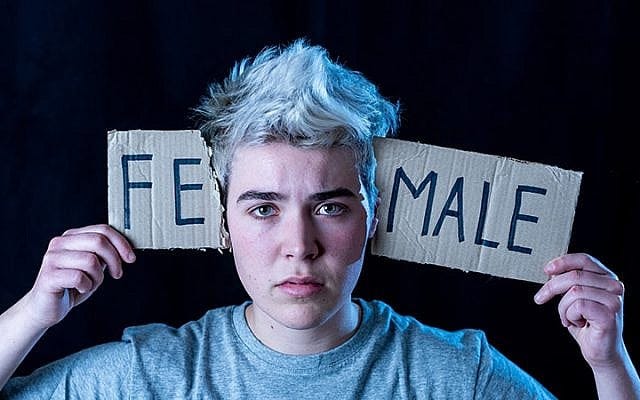
In the summer of 2023, I participated in an Israeli television panel discussion of Orthodox Judaism’s view of transexuality. My fellow panelists were an ex-Hasidic man who now identifies as an atheist female and an ex-Haredi rabbi who currently calls himself “religiously nonconforming” and serves as scholar-in-residence for Trans and Queer Jewish Studies at an LGBT synagogue.
The female-identifying ex-Hasid vehemently insisted that Orthodox Judaism needs to fully accept the choices of those who are living their lives as the sex different from the one evidenced by their genetics and bodies at birth. To accept not only the individuals as people and as Jews, but to accept the religious validity of their choices as well.
Jewish Orthodoxy, the transgender activist argued, has found ways of effectively permitting some things that the Torah forbids, like Jews owning leavened products over Pesach – which can be circumvented by selling such products to a non-Jew and then buying them back after the holiday. Why, the activist demanded, can’t a workaround be found to accommodate choices of sexual expression?
The erstwhile-Haredi rabbi stressed the Jewish ideal of “pursuing truth,” which, he declared, includes finding and embracing the truth of one’s sexual identity, regardless of what one’s body evidenced at birth or even evidences presently. People, he asserted, must find and celebrate their “authentic version of themselves.”
There can be no denying that there are people who are deeply conflicted about their gender identities. They deserve to be safe from harm and, facing challenges the rest of us don’t, deserve empathy and compassion. Dysmorphias, whether about body image or sexual identity, are real.
But the Torah and its extension, halacha, or Jewish religious law, are unequivocal about the fact that being born in a male body requires living the life of a man, and being born female entails living as a woman. Halacha disallows a Jew to undertake the guise of the other sex – it forbids even his or her wearing clothing worn by the other sex – and certainly taking steps to alter one’s sexual morphology. (Indeterminate biological sex, today called “intersex” is a very rare occurrence and is duly addressed in the Talmud.)
And, in Judaism, each gender has its particular life-role to play. The bodies God gave us are indications of what we are and what we are not, and of how He wants us to live our lives.
That is not to disparage in any way those for whom living lives in consonance with their biologies is hard, even very hard. In fact, from a Jewish perspective, people subject to sexual dysmorphia are shouldered with a special challenge to overcome in their lives, in addition to the myriad more mundane trials faced by us all.
The bottom line, though: the meaning and goal of human existence present a dichotomy: Are we here for “self-fulfillment” and comfort (to cater to what we feel is the “authentic version of ourselves”), or to live lives centered on the Divine, even if that entails discomfort?
To be sure, there are times when discomfort can be avoided, like, for Jews, the pre-Pesach sale of bread and such. Entering a legally-enforceable contract to enact such a sale renders the product no longer in the possession of its previous Jewish owner. But, alas, such “workarounds” are not available in most other matters, and in those other realms, some discomfort, even pain, may result. They are inevitable parts of all human lives.
When it comes to adultery or theft, we all readily recognize that even if one’s “authentic version” of oneself leads him or her to wish to betray a marriage or to appropriate something that belongs to another but that one feels he absolutely needs in order to feel fulfilled, one must deny one’s desire and live with – even take pride in – the discomfort. That should be true in every realm.
Because Judaism is not about our wishes but our responsibilities; not about comfort but service. Attaining ultimate meaning in our lives indeed results from “pursuing truth,” but not where truth is defined as how we feel about ourselves but, rather, as a higher truth; That of God’s will.
Self-denial is, admittedly, an unpopular notion these days. But Judaism has been stubbornly countercultural since Sinai. Just as it rejected societal stances that informed ancient Egyptian, Greek, Roman and subsequent cultures, it does not yield, either, to contemporary mores, no matter how popular they may be.
The Biblical Avraham is called “ha’ivri” in the Torah, a word that can be translated as “the other sider,” because, the Talmud teaches, “the entire [idolatrous] world was on one side” of a conceptual river and he was “on the other.”
His descendants are likewise charged with, when necessary, standing up to societal pressures in the service of higher ideals.
––––––––––––––––––––––––––––––––
The Malevolent, Mixed-Up Ms. Maqusi
This month’s winner in the “It Would Be Hilarious Were It Not So Horrific” category is unquestionably Dr. Samar Maqusi’s lecture to students at the University College London.
The lecturer, a former employee of the United Nations Relief and Works Agency for Palestine Refugees (UNRWA), was addressing the campus branch of Students for Justice in Palestine, and explained to the group how, in the 19th century, a monk disappeared and the Jewish community was accused of murdering him to use his blood in a “Tabernacles” ritual.
“The story,” she recounted, “is that during this feast they make these special pancakes, or bread. And part of the holy ceremony is that [it requires] drops of blood from someone who’s not Jewish, which the term is gentile.”
She told the students that “a group of Jews who lived in Syria admitted to kidnapping [the monk] and murdering him to get the drops of blood for making the holy bread,” Although she neglected to note that the “admissions” were the result of torture; in fact, several Jews died during their “interrogation” sessions.
In her sharing the infamous “Damascus Affair” with the students, Ms. Makusi not only confused Sukkot with Pesach, when “holy bread” is eaten, but got the year of the blood libel wrong (it was in 1840, not 1838).
But made sure that her listeners knew that, whether or not the kidnapping and murder really happened, “these are things that you read, and again, as I said, do investigate. Draw your own narrative.”
The atrocious academic was subsequently banned from the university and her bio page taken down.
But what remains is the sad fact that, had a member of “StandWithUs-UK” not infiltrated the lecture and recorded it, no one would have been the wiser. Ms. Makusi’s listeners would have come away believing in the veracity of the blood libel, and its falsehood would never have been exposed.
And sadder still, we have no idea how many other, uninfiltrated, such “lectures” may be ongoing and unnoticed.
––––––––––––––––––––––-
My most recent Ami Magazine column, “Reconstructing the Gazan Mind,” can be read at https://amimagazine.org/2025/11/11/reconstructing-the-gazan-mind/
And a thought on parshas Toldos is at:
https://www.rabbiavishafran.com/toldos-mind-hunter/
This Substack is free of charge. Should you wish to acknowledge it with a donation, though, you can do so through Substack or by clicking on “Donate” at rabbiavishafran.com .
All funds received will go to help support dedicated marbitzei Torah.
PLEASE ENCOURAGE YOUR FRIENDS AND RELATIVES TO SUBSCRIBE FOR FREE TO THIS SUBSTACK.